DIRECT ANSWER
Intumescent coatings improve fire protection by reacting to extreme heat and expanding up to 100 times their original thickness to form a thick, insulating carbonaceous char layer. This char has very low thermal conductivity, which dramatically slows heat transfer to the structural steel, timber or concrete beneath it. By delaying the point at which steel reaches its critical failure temperature, intumescent coatings extend evacuation time, support firefighter response and help prevent premature structural collapse, all while preserving a clean architectural finish.
Understanding how intumescent coatings improve fire protection starts with one core idea: they are a passive fire protection system that reacts automatically to heat, with no power source, activation switch, or maintenance schedule required. For architects, engineers, and building owners specifying fireproofing for exposed structural steel, intumescent coatings offer a rare combination of code-compliant fire resistance and an unobtrusive, paint-like finish.
What Are Intumescent Coatings?
Intumescent coatings are fireproofing materials applied to structural steel (and sometimes timber or concrete) to provide an engineered fire-resistance rating. Under normal conditions, they look and behave like a standard paint or thin decorative finish. It is only when exposed to fire-level heat that their protective chemistry activates.
How Intumescent Coatings Work, Step by Step
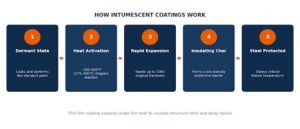
Intumescent coatings provide passive fire protection by reacting to extreme heat. Unlike conventional coatings, they remain unchanged during normal service conditions but rapidly expand when exposed to fire, creating an insulating char barrier that helps protect structural steel and delay potential failure.
1. Dormant State
Under everyday conditions, the coating performs like conventional paint, offering a smooth, uniform, architectural-grade finish that preserves the visual lines of exposed steel beams and columns.
2. Heat Activation
When surface temperatures reach approximately 350°F to 400°F (175°C to 200°C) during a fire, internal chemical components, typically an acid source and a carbon source, trigger a chemical reaction within the coating.
3. Rapid Expansion
The reaction releases gases that cause the coating to puff up into a low-density, insulating foam, expanding to as much as 100 times its original dry-film thickness.
4. Formation of the Insulating Char Layer
The expanded material forms a thick, carbonaceous char with very low thermal conductivity. This char layer acts as a thermal barrier, dramatically slowing the rate at which heat reaches the underlying structural steel, timber, or concrete substrate.
5. Steel Protected
By delaying the rate at which heat reaches critical temperatures, the char layer helps preserve the load-bearing capacity of structural steel. This additional protection can extend evacuation time, support firefighter operations, and help meet fire-resistance requirements specified by building codes.
Why Structural Steel Needs Fire Protection
Steel is strong and versatile, but it loses structural strength rapidly as temperatures rise in a fire. Once steel reaches its critical failure temperature, generally cited in the range of 500°C to 600°C, it can no longer support its design load, risking deformation or collapse. Because commercial and industrial construction relies heavily on exposed or lightly protected steel framing, passive fire protection is a critical part of life-safety design.
How Intumescent Coatings Delay Structural Failure
By insulating the steel from the full intensity of fire-level heat, the char layer slows the rate of temperature rise within the steel section. This buys time before the steel approaches its critical failure temperature, directly delaying the point at which structural strength is lost.
| By slowing heat transfer to structural steel, an intumescent char layer helps a building hold its structural integrity longer, giving occupants time to evacuate and firefighters time to respond. |
Benefits of Intumescent Coatings
Extends Evacuation Time
Certified passive fire protection systems typically provide fire resistance ratings ranging from 30 to 120 minutes, and in some systems longer, giving building occupants critical time to evacuate safely and firefighting crews time to respond.
Supports Code Compliance
Intumescent products are tested to recognized fire-testing standards and provide documented fire-resistance ratings, helping buildings meet local and national fire safety code requirements.
Preserves Architectural Appearance
Unlike bulky cementitious sprays or heavy fireproofing wraps, thin-film intumescent coatings maintain the smooth, clean visual lines of exposed architectural steel and timber, an important consideration for lobbies, atriums, and other visible structural features.
Lightweight and Space-Efficient
Intumescent systems add minimal load to a structure compared with traditional cementitious fireproofing, and their thin-film application helps preserve usable floor space and ceiling height.
Intumescent Coatings vs Other Fireproofing Methods
| Factor | Intumescent coatings | Cementitious / spray fireproofing |
| Appearance | Smooth, paint-like finish; preserves exposed steel look | Textured, bulky spray finish; typically concealed |
| Weight | Lightweight, thin-film application | Heavier, adds more structural load |
| Best suited to | Exposed architectural steel, visible structural elements | Concealed steel, back-of-house or industrial applications |
| Fire resistance range | Commonly 30 to 120+ minutes depending on product/thickness | Often provides longer ratings at greater thickness |
| Maintenance | Minimal, durable finish with proper application | Can be more prone to damage or degradation over time |
Where Are Intumescent Coatings Commonly Used?
- Exposed structural steel beams and columns in commercial buildings
- Atriums, lobbies and open-concept architectural spaces
- Industrial facilities with structural steel framing
- Parking structures and mixed-use developments
- Institutional buildings requiring code-compliant fire protection with an architectural finish
Many industrial facilities, manufacturing plants, and institutional projects require contractors to meet strict safety and compliance standards. As an ISNetworld member, Central Painting supports clients that require contractor prequalification and documented safety compliance as part of project delivery.
How Central Painting Supports Fire Protection Projects
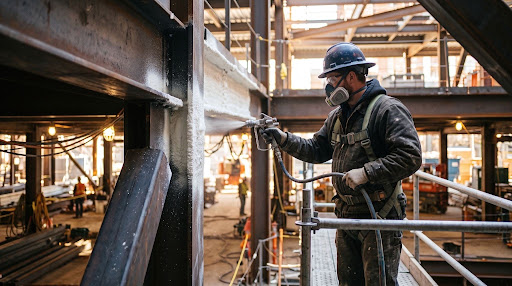
Central Painting is a certified applicator of intumescent coatings for commercial and industrial facilities across Canada. Our teams apply coatings in controlled thicknesses to meet engineered fire-resistance requirements for different steel components, combining code-compliant protection with a clean, professional architectural finish.
Learn more about our Intumescent Coatings services, explore related Industrial Painting and Institutional Painting capabilities, browse completed projects in our Portfolio, or contact our team to discuss your fire protection project.
Fire Resistance Quick Reference
| Rating range | Typical use case |
| 30 minutes | Lower-risk applications, some interior architectural steel |
| 60 minutes | Common commercial and institutional applications |
| 90 minutes | Higher-risk occupancies and larger structural members |
| 120+ minutes | Critical structural elements and high life-safety requirements |
Exact fire-resistance ratings depend on the specific product, dry-film thickness, and the size and shape of the steel member being protected. Always confirm requirements with a qualified fire protection engineer and the coating manufacturer’s tested system.
Frequently Asked Questions
| How do intumescent coatings work?
Intumescent coatings remain dormant like standard paint until exposed to fire-level heat, typically around 350°F to 400°F. At that point, they expand up to 100 times their original thickness, forming an insulating char layer that slows heat transfer to the structural steel underneath. |
| How much fire resistance do intumescent coatings provide?
Depending on the specific product and applied thickness, intumescent coatings can provide certified fire-resistance ratings commonly ranging from 30 to 120 minutes or more. The exact rating depends on the tested system and the steel member being protected. |
| Do intumescent coatings affect the appearance of steel?
No, they are designed to preserve it. Unlike bulky cementitious fireproofing, thin-film intumescent coatings maintain a smooth, paint-like finish that keeps exposed architectural steel beams and columns visually clean. |
| Are intumescent coatings required by code?
Passive fire protection is often required by building and fire codes for structural steel in commercial and institutional buildings. Intumescent coatings are one certified method of meeting these requirements; a fire protection engineer can confirm the specific rating required for your project. |